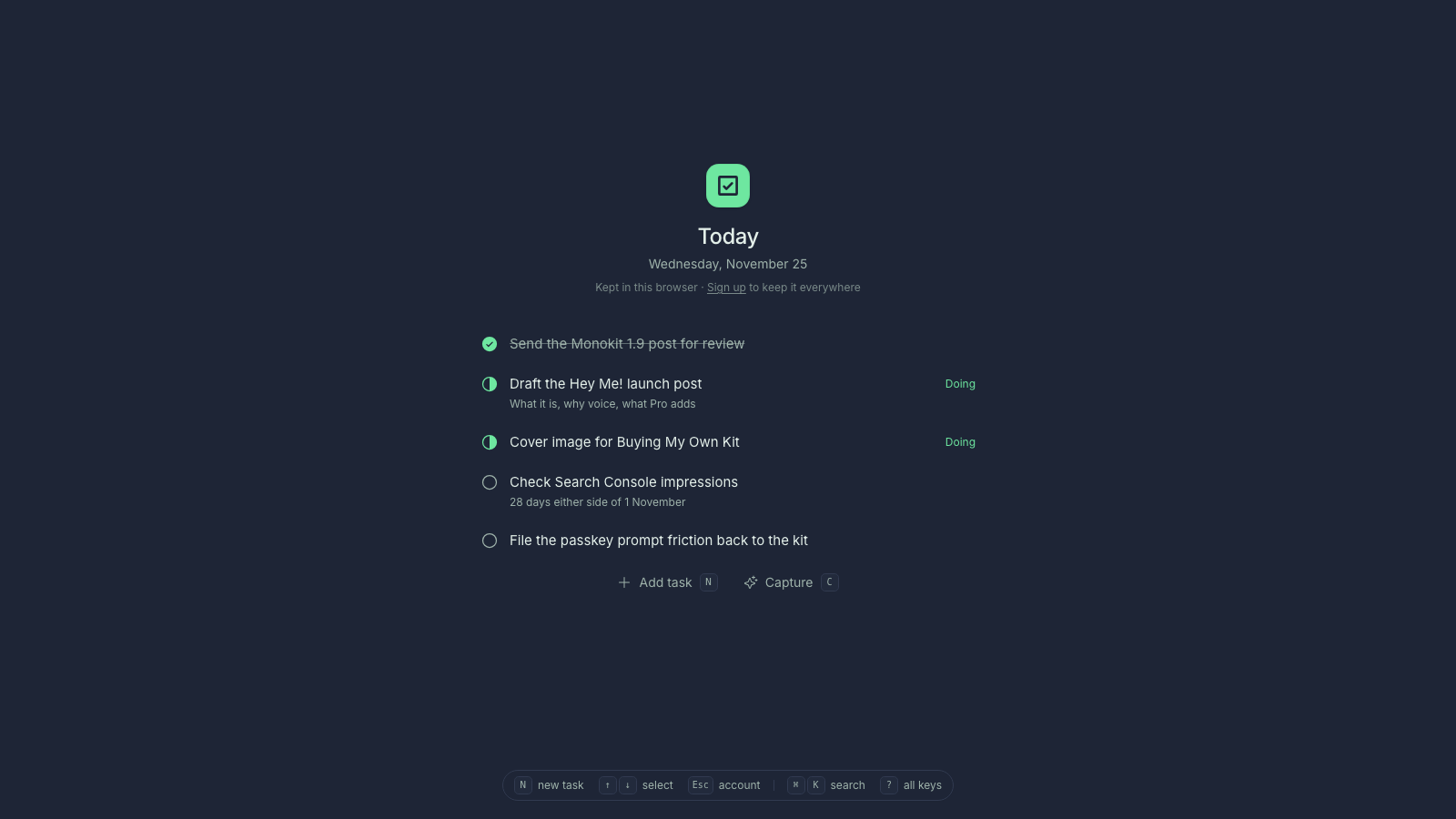
The person who makes a starter kit is the worst-placed person to test it. I know which files are demo scaffolding and which are meant to stay. A buyer doesn't.
So on 13 November I cloned Monokit, my own kit, the way a buyer would: a fresh repo, the kit as an upstream remote, and a rule that kit files stay as shipped. Twelve days later it's Hannde, an AI-first to-do app at hannde.app. It has been my to-do list since 15 November, and this week it replaced Asana.
The kit stays unedited
Monokit ships a demo store and demo chrome: sample projects, a trial banner, a fake session. Rather than edit those files, Hannde swaps them out with tsconfig path aliases that point the kit's imports at real modules.
That keeps updates cheap. When Monokit 1.9 came out on 18 November, Hannde took it with a plain git merge.
Every time I had to reach into a kit file anyway, it went into a friction log. On the first day that was thirteen entries, and all thirteen went back to the kit as issues. The sign-in block, for one, was a demo with no props, so a buyer couldn't wire it to real auth without rebuilding the form.
A real backend under kit components
Underneath sit Neon, Better Auth (magic links and passkeys) and Drizzle. Every query is bound to one owner, and the tests try to read, write and delete across accounts to prove it.
The model suggests, the app decides
The AI features run on the AI SDK through Vercel's AI Gateway. Capture turns a pasted note into draft tasks. Today ranks the day's tasks with a reason for each, and falls back to due dates when the model doesn't answer. Chat in ⌘K plans changes across projects.
None of that output is trusted. Every id and every change the model proposes is checked against the user's own tasks before anything is written.
Faster by thinking less
Haiku 5.5 thinks by default through the gateway, about 600 reasoning tokens a call. For parsing and ranking that's waste: turning it off took Capture from 8.2 seconds to 3.0.
Then it started miscounting. It wrote "Four tasks…" over a list of three, and telling it not to didn't help. The fix was the order of the output: the model returns the task ids first and writes its reply after, and the app renders the list from the ids.
Chat went the other way. With no thinking at all, the model narrated its reasoning into the reply before calling a tool. Low effort stops that, at four or five seconds a turn.
Open to agents
Hannde is also an MCP server. claude.ai connects to it with a normal sign-in and a consent page; scripts use personal access tokens, stored only as hashes. Both share one limit of 60 calls a minute.
My assistant, Mini, reaches it through a Claude Code plugin that reads its token from the Keychain. She can suggest tasks, but nothing she writes lands until I press Approve.
What it is now
Basic is free and needs no account: a Today list that lives in your browser. Personal, at $5 a month, keeps that list in your account and adds Capture, chat and the MCP connection. Pro, at $15, is the full app with projects, boards and tables. Team is a waitlist.
I built it with Claude Code, one worktree and one pull request per change: 39 so far.
Thirteen issues on day one. A buyer would have hit every one of them, and unlike me, they couldn't have fixed the kit.