Building a Portfolio Web App: Agents, HITL, and 99 RES
The 80/20 pattern of AI-assisted development — and what it takes to hit 99 RES with a portfolio you fully control.
How I rebuilt my portfolio as a real web app, what the HITL + agent development loop actually looks like, and what 99 RES means when you own your stack.
Most portfolios are templates with content dropped in. Mine was too: a static site that worked fine until I started working seriously with AI agents. Then I needed something malleable, a real web app with routing, typed data and a codebase an agent could find its way around.
So I rebuilt it, properly this time.
Why the old site had to go
The old site looked fine but fought every change. A new case study meant editing several files by hand, keeping formats in sync and hoping nothing broke. I couldn't hand that to an agent, and I couldn't iterate on it quickly myself.
The new site is a Next.js app with typed data, MDX content, a design system (MDS) and enough structure that I can describe a change to Claude Code and have it land cleanly, often first time.
That structure is what makes the human-in-the-loop part work. I set direction, review decisions and redirect when the model drifts. The agent does the construction.
The 80/20 wall
I hit the same wall every time.
The first 80% of a feature moves fast. The agent reads the codebase, matches the existing patterns and wires things together. Work that used to take a few hours to spec, scaffold and build now takes under an hour, sometimes much less.
Then comes the last 20%: visual tweaks, edge cases, copy that has to sound like me rather than a competent generalist. That takes the other 80% of the calendar. Not because the agent can't help (it can), but because refinement is iterative. I'm narrowing in on a specific result, and that needs short feedback loops and judgment I can't fully hand over.
That's not a complaint. The time I get back on construction is real, and the last 20% is just what craft looks like.
Owning the performance
Hosted platforms make the performance choices for you: rendering strategy, asset pipeline, JS budget, font loading. If it's slow, that's the price of convenience.
Owning the stack means I get to choose. Static generation wherever possible, next/image for every image, next/font so type never shifts the layout, code splitting that follows how people actually move through the site, and no third-party scripts blocking render.
I added Vercel Speed Insights after the build, because field data from real visitors tells you more than a lab score.
The numbers
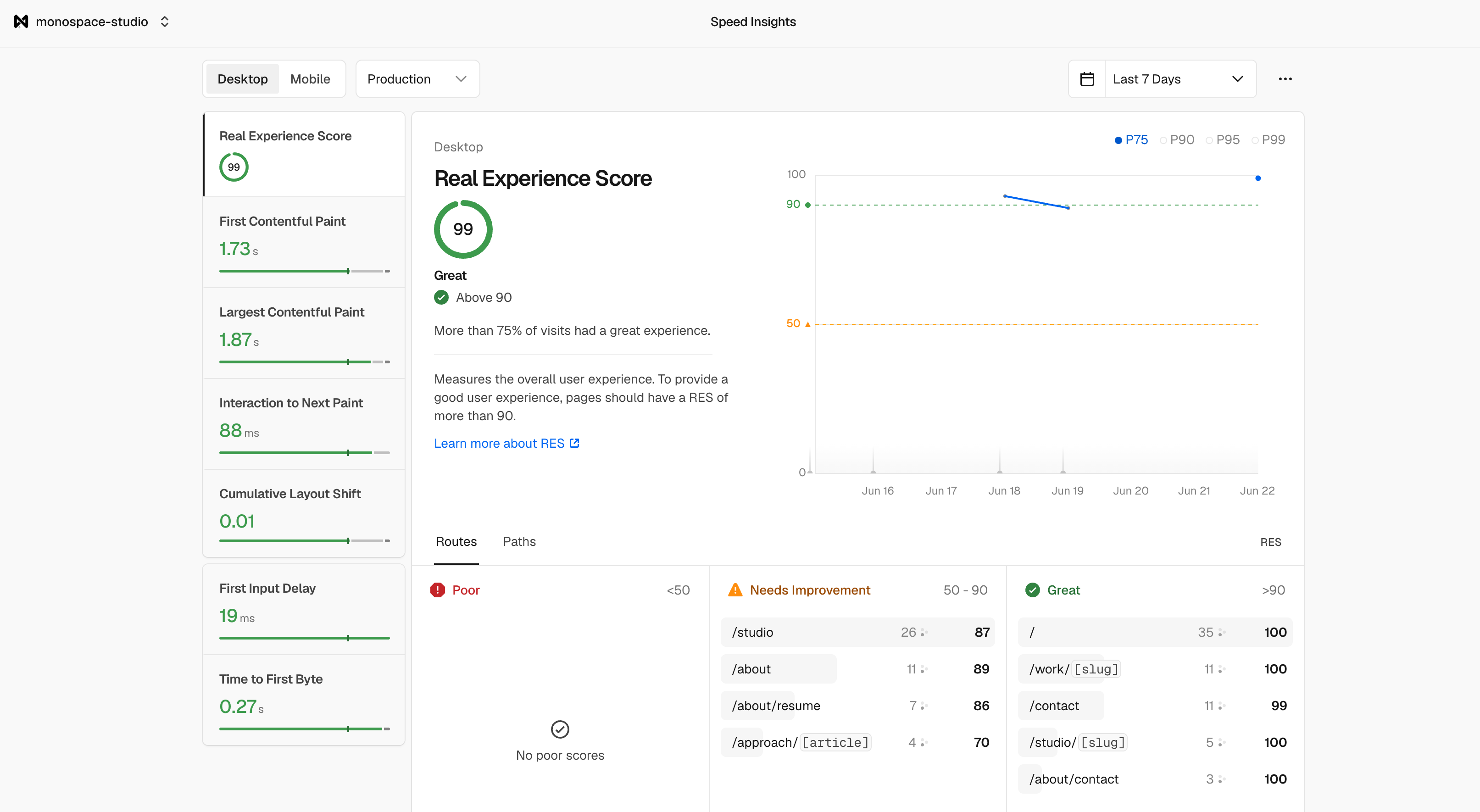
The Real Experience Score sits at 99 on desktop. At P75, more than 75% of visits had a great experience:
| Metric | Result |
|---|---|
| First Contentful Paint | 1.73s |
| Largest Contentful Paint | 1.87s |
| Interaction to Next Paint | 88ms |
| Cumulative Layout Shift | 0.01 |
| Time to First Byte | 0.27s |
Home, work entries and individual studio posts score 100, and contact scores 99. The content-heavy routes need work: /blog (87), /about/resume (86) and the /approach articles (70). That last one is next.
The score isn't the point. The point is that performance is something I can measure and improve, not something that happens to the site.
A portfolio that's also a product
It's versioned, tested and monitored. I run agent sessions against it all the time: adding range entries, shipping posts like this one, iterating on components. I make every decision, but I don't do the mechanical work.
A Squarespace template can't give you that, and neither can AI on its own. It takes an agent that builds and an owner who decides.
That's the portfolio I wanted to build.