Automation Solves Output. It Doesn't Solve Outcomes.
I drew two charts to separate two claims that get flattened into one: more automation always means more output, but outcomes peak and then fall. Then I watched my own audit agent sit on the wrong side of the second chart for fifteen mornings straight.
More automation always means more output. That part isn't in question — plot automation against output and the line only goes up. What's rarely on the same page is what happens to outcomes once you get there.
I drew two charts to keep the two claims separate.
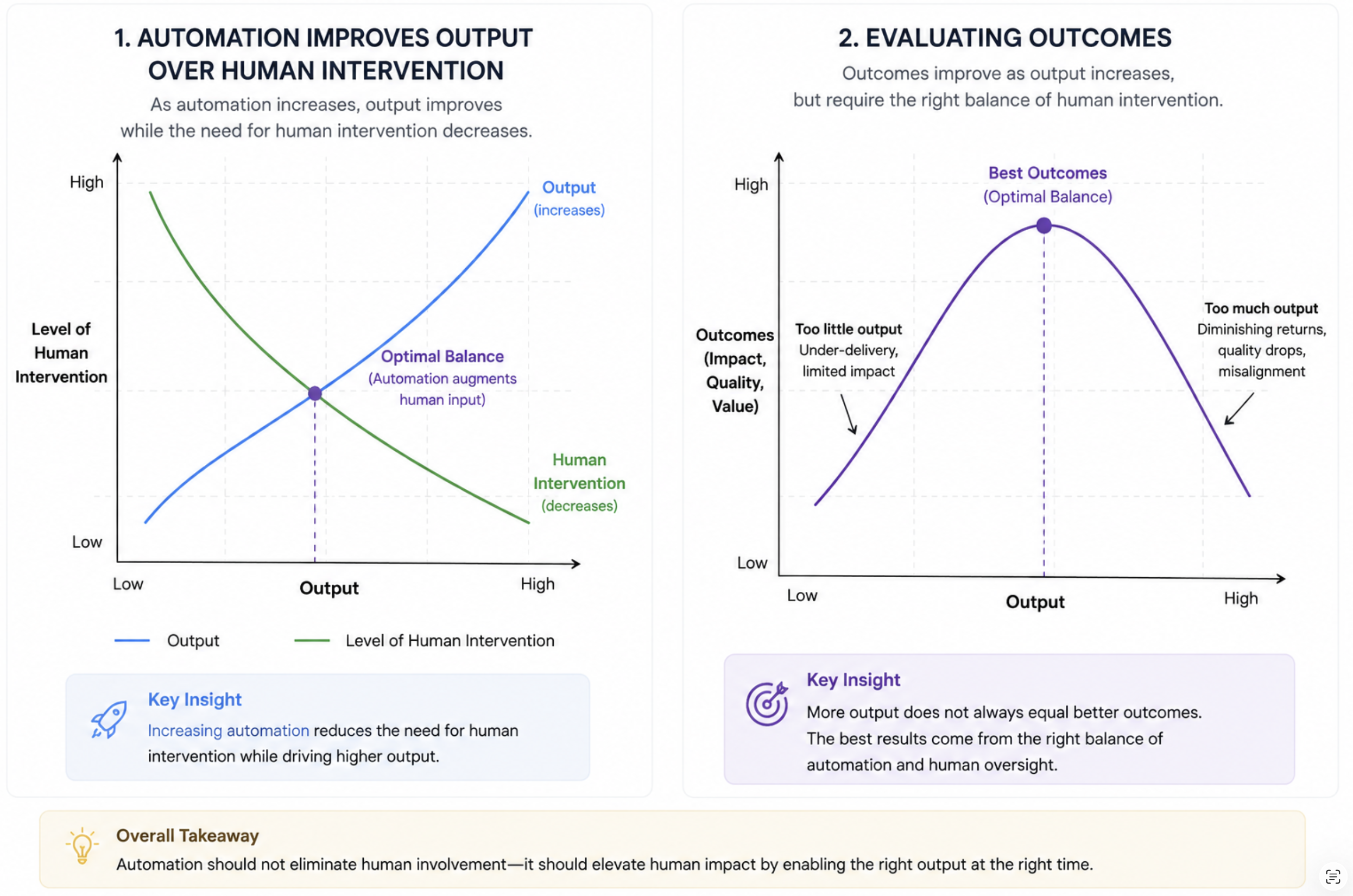
The first chart is the pitch everyone makes
Output goes up, human intervention goes down, and the two lines cross at a tidy "optimal balance." That's the automation pitch in one picture: put in less of yourself, get more of the thing out. It's true as far as it goes. It's also the only chart most AI adoption decks show.
The second chart is the one that matters
Outcomes — impact, quality, whether the thing actually lands — don't rise in a straight line with output. They rise, peak, then fall. Too little output and you've under-delivered. Too much and you get diminishing returns: volume without judgment, quality drops, the output drifts from what anyone actually asked for. The best outcomes sit in the middle, not at either edge, and getting there takes the right amount of human oversight, not the least amount.
I've watched the far side of that curve happen
I run Ledger, an agent whose only job is auditing four other agents that build, review, and merge code with no human in the loop. It caught a real bug once. Then it opened the same issue fifteen mornings running against a PR I'd built as a test fixture and forgotten to close. Ledger was right every time — it has no branch in its logic for "this one's mine, go easy" — which is exactly the problem. Nothing in the pipeline could tell a genuine gap from a test I'd meant to clean up two weeks earlier. Maximum output, zero judgment about whether the output still meant anything.
That's the right-hand tail: not a broken agent, a system running at full automation with nobody positioned to ask whether it should still be running.
What "optimal balance" actually means
It's not a ratio you set once. It's a point that moves with the cost of being wrong. Ledger auditing PRs can run almost unsupervised — a bad issue costs someone thirty seconds to close. A pipeline that ships to production, or drafts something with my name on it, needs a lot more of me in the loop, because the cost of drifting off-target is higher. The chart doesn't hand you a fixed setting. It tells you the shape of the trade-off you're actually managing.
I said this back in 2023, before most of this existed: AI is a lever, and a lever needs a skilled operator. Three years and one autonomous pipeline later, I have the receipts. The operator's job was never to slow the lever down. It's to know when the lever has stopped pointing at anything worth pulling.